What Does "Term-Time Only" (TTO) Mean in UK Education?
In UK state schools, academies, multi-academy trusts (MATs), and local authorities, support roles such as Teaching Assistants (TAs), Higher Level Teaching Assistants (HLTAs), cover supervisors, midday meal supervisors, and laboratory technicians are routinely advertised as Term-Time Only (TTO).
When reviewing a vacancy advert, the headline salary is almost universally published as the Full-Time Equivalent (FTE)—the gross annual salary an employee would receive if working full-time (typically 37 hours per week) for a full 52-week calendar year.
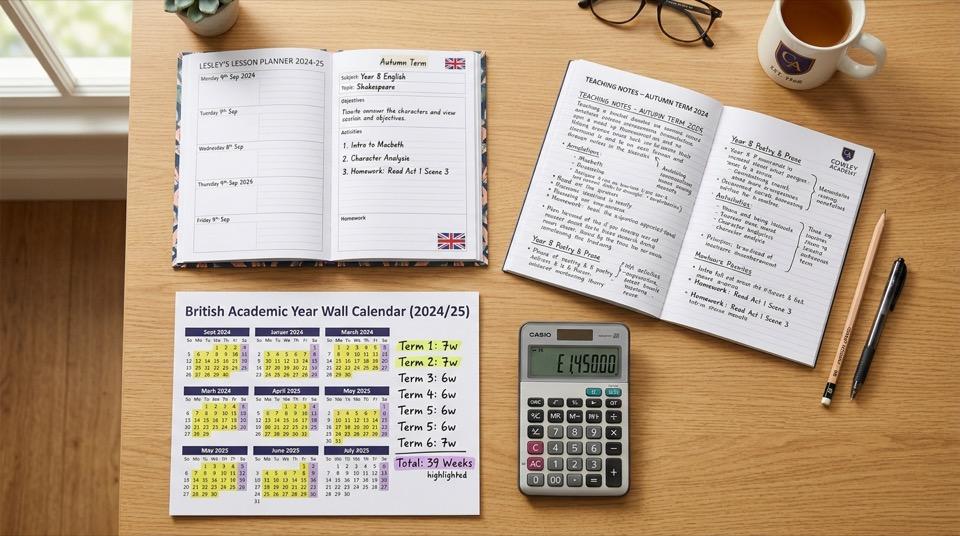
Because school staff work only during the 38 or 39 weeks per year when pupils attend school, their actual salary is scaled down. Unlike casual zero-hours work, however, TTO positions are permanent contracts that include full accrued statutory annual leave and equal monthly payment protection.
The Universal Term-Time Only Pro Rata Formula
Term-time only calculations involve two independent scaling adjustments: one for weeks paid during the year, and one for weekly hours worked:
Where:
- FTE Annual Salary: The benchmark full-time rate (e.g. £24,000 on the NJC pay spine).
- Paid Weeks: 39 working term weeks plus your statutory/contractual holiday entitlement (typically 43.5 to 45.4 weeks).
- 52.14 Weeks: The accounting constant representing the true average weeks in a calendar year (365 days ÷ 7 days = 52.1428 weeks). Some employers round this to 52.0.
- Contracted Hours: Your weekly scheduled hours (e.g. 30 hours per week).
- Standard Full-Time Hours: The employer's full-time baseline (37 hours per week across England & Wales under NJC rules; 36 hours in London boroughs).
How Are "Paid Weeks" Calculated? (39 Weeks + Holiday)
A common misconception among new school staff is that their pay only reflects 39 weeks of work. In the United Kingdom, all workers are legally entitled to statutory paid annual leave under the Working Time Regulations 1998 (5.6 weeks statutory minimum).
Because TTO staff cannot take annual leave during term time, their holiday entitlement is converted into additional paid weeks added to their contracted 39 weeks:
| Component | Weeks Allocated | Description |
|---|---|---|
| Teaching Term Weeks | 38.0 to 39.0 weeks | 190 compulsory statutory pupil teaching days per academic year |
| INSET Training Days | 1.0 week (5 days) | In-service teacher and support staff professional training sessions |
| Pro Rata Annual Leave | 4.5 to 5.4 weeks | Statutory 5.6-week entitlement scaled to term time (or NJC Green Book scaled entitlement) |
| Total Paid Weeks | 43.5 to 45.4 weeks | Contractual paid weeks used in payroll proration |
Note on Length of Service: Under NJC Green Book terms, staff who achieve 5 years of continuous local government service receive an additional 5 days (1 full week) of contractual annual leave, increasing their paid weeks to approximately 45.4 weeks.
Why Do TTO Staff Receive Pay in August?
One of the most frequent questions asked by newly hired school employees is: "Do teaching assistants get paid during the six-week summer holiday?"
Yes, you receive equal payslips every single month.
To provide financial stability, UK education payroll divides your total annual pro rata compensation into 12 equal monthly instalments (Annual Pro Rata Salary ÷ 12).
In effect, a portion of the earnings you accumulate during heavy term-time working months (September, October, January, March) is deferred by the payroll system and disbursed during school closure periods in December, April, and August.
Term-Time Only Salary Reference Matrix (Based on 37h Full-Time)
Quick reference guide showing estimated annual and monthly gross pay across standard UK local government NJC salary points:
| FTE Annual Salary | Hours / Week | Paid Weeks | Pro Rata Factor | Actual Annual Pay | Monthly Pay (12x) |
|---|---|---|---|---|---|
| £22,000 | 30.0 hrs | 44.0 wks | 68.42% | £15,052.40 | £1,254.37 |
| £24,000 | 30.0 hrs | 44.0 wks | 68.42% | £16,420.80 | £1,368.40 |
| £24,000 | 32.5 hrs | 44.0 wks | 74.12% | £17,789.20 | £1,482.43 |
| £26,000 | 30.0 hrs | 44.0 wks | 68.42% | £17,789.20 | £1,482.43 |
| £28,000 | 35.0 hrs | 44.0 wks | 79.82% | £22,349.60 | £1,862.47 |
Worked TTO Salary Calculation Examples
Example 1: Teaching Assistant (30 Hours, 44 Paid Weeks)
Full-time advert states £24,000 for 37 hours. Candidate contracts for 30 hours over 39 term weeks + 5 weeks holiday (44 paid weeks):
- • Weeks Factor: 44.0 ÷ 52.14 = 84.39%
- • Hours Factor: 30.0 ÷ 37.0 = 81.08%
- • Pro Rata Factor: 0.8439 × 0.8108 = 0.6842
- • Annual Salary: £24,000 × 0.6842 = £16,420.80
- • Monthly Gross: £16,420.80 ÷ 12 = £1,368.40
Example 2: Cover Supervisor (Full Term Hours, 37 Hours)
Role offers £27,000 full-time. Staff works full 37-hour weeks during term (100% hours factor), paid for 44 weeks:
- • Weeks Factor: 44.0 ÷ 52.14 = 84.39%
- • Hours Factor: 37.0 ÷ 37.0 = 100.00%
- • Pro Rata Factor: 0.8439 × 1.0000 = 0.8439
- • Annual Salary: £27,000 × 0.8439 = £22,785.30
- • Monthly Gross: £22,785.30 ÷ 12 = £1,898.78
Leaving Mid-Year: The Term-Time Reconciliation Audit
Because monthly payslips distribute 39 working weeks across 52 calendar weeks, leaving an employer midway through an academic year requires a term-time reconciliation audit:
- Leaving at Christmas or Easter: In the autumn term, you work roughly 14 to 15 weeks out of 39 (38% of your total working obligation), but you will only have received 4 months of pay (33% of your annual earnings). Your school payroll must pay you a balancing settlement on your final payslip to credit the extra weeks worked.
- Leaving in July before August: If you work through to the end of the summer term in July, you have completed 100% of your contractual term-time work for that academic year. You are legally entitled to receive your normal salary through July and August.
Explore Related Calculation Tools
Need to convert hours or check statutory annual leave for commercial positions? Use our dedicated free calculators:
Frequently Asked Questions (Term-Time Only)
Everything you need to know about school support contracts, paid weeks, and August pay.